If you are involved in designing a building, specifying its services, or managing an existing one, elevator traffic analysis is a discipline you need to understand, even if you are not the one carrying it out. Decisions about lift quantity, capacity, speed, and control configuration have lasting consequences for how a building functions and how its occupants experience it. Getting those decisions right requires analysis, not intuition. This guide explains what elevator traffic analysis involves, why it matters, and how it fits into the wider design and management process.
Elevator traffic analysis is the process of evaluating how a lift system performs against the demands placed on it by a building’s occupants. It examines how many people need to move between floors, when they need to do so, and how the lift system responds to those demands under different conditions.
At its core, traffic analysis seeks to answer a straightforward question: does this lift system provide an acceptable level of service for this building? The answer depends on a set of quantifiable performance metrics, principally waiting time, journey time, handling capacity, and interval, which are measured against benchmarks appropriate to the building type and use.
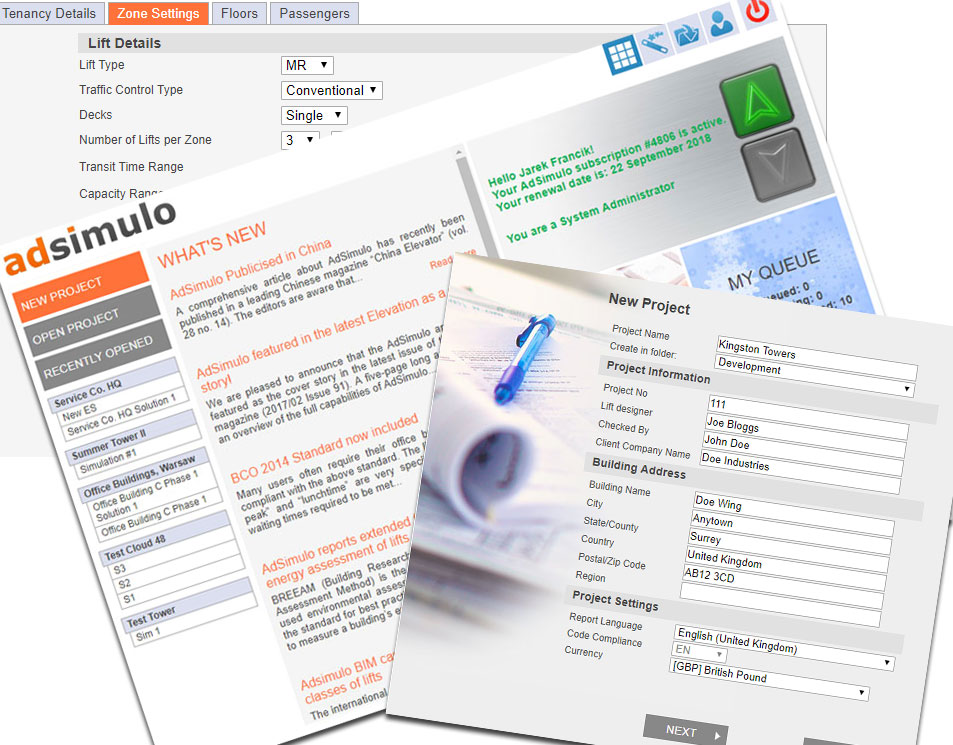
There are two primary methods of conducting elevator traffic analysis: mathematical calculation and digital simulation. Calculation methods use established formulae to estimate performance under simplified assumptions. Simulation methods, as used by AdSimulo, model the system dynamically, replicating individual passenger behaviour and system responses to produce more accurate results, particularly for complex or mixed-use buildings.

For architects, elevator traffic analysis is a design input as much as a post-design check. The number of lifts required, and the space those lifts occupy in the building’s core, is one of the most significant structural and spatial decisions in a tall building’s design. Get it wrong and the consequences are difficult to reverse.
Early-stage elevator traffic analysis allows architects to test the implications of different core configurations before they are committed to the structural design. How does a four-lift arrangement compare to six lifts of smaller capacity? What is the effect of splitting lifts into high-zone and low-zone groups? These are questions that traffic analysis answers with data, enabling informed decisions that balance performance, cost, and spatial efficiency.
It also provides the documentation needed to demonstrate to clients and planning authorities that the building’s vertical transportation provision is fit for purpose, an increasingly important consideration in larger commercial and mixed-use developments.
For facility managers, elevator traffic analysis is a tool for understanding and improving an existing system. Buildings change over time: occupancy increases, tenants change, floors are repurposed, and the original design assumptions may no longer reflect reality. When occupants begin complaining about wait times, or when peak periods create visible congestion at lobby level, traffic analysis is the appropriate starting point for diagnosis.
A proper elevator traffic analysis of an existing building will identify whether the issue lies in the number of lifts, their configuration, the control system logic, or the way in which demand is distributed across the day. It provides a factual basis for decisions about maintenance, modernisation, or operational changes, rather than relying on anecdote or reactive fixes.
Elevator traffic analysis does not operate in a vacuum. It is framed by a body of professional standards and guidance that define acceptable performance levels for different building types. In the UK and internationally, CIBSE Guide D: Transportation Systems in Buildings is the primary reference document for vertical transportation design and analysis, covering traffic calculation methodology, performance benchmarks, and simulation requirements Compliance with these benchmarks is not merely a technical formality; it is the professional standard against which any lift system specification will be evaluated.
For new buildings, meeting CIBSE Guide D benchmarks for waiting time and handling capacity is the baseline expectation. For existing buildings undergoing review, the same benchmarks provide the reference point for assessing whether current performance is acceptable and what level of improvement is achievable.

A thorough elevator traffic analysis for a building project or review typically involves the following steps:
The output is a clear, evidence-based specification for the lift system, or a set of recommendations for an existing one, supported by quantified performance data.
AdSimulo is designed for professionals who need to conduct elevator traffic analysis to a rigorous standard without unnecessary complexity. Whether you are specifying a lift system for a new building or reviewing performance in an existing one, AdSimulo provides the simulation capability and reporting tools to do the job properly.
Request a demo today and see how AdSimulo supports elevator traffic analysis from initial concept through to final specification.
Elevator traffic analysis is the broader discipline of evaluating lift system performance against demand. It can be conducted using mathematical calculation methods or digital simulation. Elevator traffic simulation is a specific method of carrying out that analysis, using dynamic modelling software to replicate passenger behaviour and system responses more accurately than calculation alone allows.
Benchmarks vary by building type. For a typical commercial office building, CIBSE Guide D recommends an average waiting time of no more than 30 seconds and a handling capacity of at least 12 to 15 percent of building population in a five-minute up-peak period. Residential, hotel, and mixed-use buildings have different benchmarks appropriate to their occupancy and usage patterns.
Yes. Thorough elevator traffic analysis often identifies configurations that deliver equivalent or better performance with fewer or differently specified lifts. Oversizing a lift core is a common and costly outcome of insufficient analysis. Simulation-based analysis gives designers the confidence to optimise the specification rather than default to conservative assumptions.
Building use is fundamental to elevator traffic analysis. An office building has a very different traffic profile to a hotel, a residential tower, or a hospital. Each generates different peak periods, different passenger volumes, and different expectations for service quality. AdSimulo models all major building types and allows custom traffic profiles to be defined for mixed-use or unusual programmes.
In the UK, building regulations do not explicitly mandate elevator traffic analysis as a named process, but compliance with accessibility and building services standards effectively requires that lift provision is properly designed. For larger or more complex buildings, demonstrating that vertical transportation provision meets professional standards such as CIBSE Guide D is increasingly expected by clients, planning authorities, and building control bodies.

We use cookies to improve your experience on our site. By using our site, you consent to cookies.
Manage your cookie preferences below:
Essential cookies enable basic functions and are necessary for the proper function of the website.
Google reCAPTCHA helps protect websites from spam and abuse by verifying user interactions through challenges.
Google Tag Manager simplifies the management of marketing tags on your website without code changes.
Statistics cookies collect information anonymously. This information helps us understand how visitors use our website.
SourceBuster is used by WooCommerce for order attribution based on user source.
Marketing cookies are used to follow visitors to websites. The intention is to show ads that are relevant and engaging to the individual user.
Facebook Pixel is a web analytics service that tracks and reports website traffic.
Service URL: www.facebook.com (opens in a new window)
You can find more information in our Cookie Policy and Privacy Notice.