If you are designing, installing or managing a lift in Singapore or Hong Kong, two different sets of rules apply. Singapore regulates lifts through the Building and Construction Authority (BCA), with SS 550 as the core code, while Hong Kong’s Electrical and Mechanical Services Department (EMSD) enforces the Lifts and Escalators Ordinance (Cap. 618) and its codes of practice. This guide sets out the lift requirements Singapore and Hong Kong apply to design, fire lifts, permits, maintenance and older elevator installations, and the one thing neither code decides for you: how many lifts a building needs.
Both cities are dense, high-rise markets where lifts carry most journeys, so their regulators are strict about safety and record-keeping. The detail below is a summary for planning, not a substitute for the codes themselves; always check the current edition and confirm clauses with a registered engineer before relying on them.
Lift Requirements Singapore and Hong Kong Apply at a Glance
Singapore and Hong Kong both require lifts to be installed, maintained and examined by registered contractors, and both require at least 1 annual examination before a lift can keep running. The main difference is structure: Singapore issues a Permit to Operate each year, while Hong Kong issues a use permit after each periodic examination.
The headline lift requirements Singapore and Hong Kong set are:
- Singapore regulator: the Building and Construction Authority (BCA), under the Building Control Act, with the Singapore Civil Defence Force (SCDF) setting fire lift rules in the Fire Code.
- Singapore design code: SS 550, the code of practice for the installation, operation and maintenance of electric passenger and goods lifts.
- Singapore operation: a Permit to Operate (PTO) from BCA, renewed after annual examination, inspection and testing.
- Hong Kong regulator: the EMSD, under the Lifts and Escalators Ordinance (Cap. 618), with the Buildings Department and the Fire Services Department covering building and fire aspects.
- Hong Kong design codes: the EMSD Code of Practice on the Design and Construction of Lifts and Escalators, and the Code of Practice for Lift Works and Escalator Works.
- Hong Kong operation: periodic examination at intervals of no more than 1 year for lifts, with a use permit showing its validity period.
Each of these is covered in more detail below, starting with Singapore.
Who Regulates Lifts in Singapore?
The lift requirements Singapore enforces come from the BCA under the Building Control Act, which treats lifts, escalators and mechanised car parks as fixed installations. Fire lifts are set by the SCDF Fire Code 2023, and accessibility features by the BCA Code on Accessibility in the Built Environment.
The BCA is responsible for the lift from design through to operation. Lift plans are submitted as part of the building approval process, a Specialist Professional Engineer (SPE) supervises and certifies the installation, and the owner must obtain a Permit to Operate before the lift can be used. The BCA also registers the service contractors who maintain and test lifts.
The SCDF sets the requirements for fire lifts, including when they are needed, how many there must be and how they are protected. The Fire Code states plainly that all lift installations and operations must comply with SS 550, so the two sets of rules work together rather than separately.
For owners, the BCA’s guidance is clear that lift safety is a legal duty. The rest of the lift requirements Singapore sets are about making sure that duty is carried out by registered, qualified people and checked every year. Our guide to lift and elevator standards explains how codes like SS 550 relate to the European EN 81 series.
SS 550: The Singapore Lift Code
SS 550 is Singapore’s code of practice for electric passenger and goods lifts, covering installation, operation and maintenance. The 2020 edition, SS 550:2020, applies to lifts in projects whose first submission was made from 1 July 2021, with older projects able to follow the 2009 edition.
Most of the technical lift requirements Singapore applies come from SS 550, which sets the safety rules for the lift itself: the machinery, brakes, safety gear, doors, controls and emergency features. It is the reference point for the inspection reports used during commissioning and annual testing, which check items such as stopping accuracy, the brake’s ability to stop a fully loaded car at rated speed, safety gear tests at 125% load and the emergency intercom.
The 2020 edition brought Singapore closer to modern European practice. It added type-testing requirements for lift models and safety components, including programmable electronic systems used in safety applications, and the BCA’s certificate of supervision was updated to include type-testing declarations. In practice, this means a lift product needs evidence that it has been tested to the standard before it can be approved.
SS 550 also covers features that affect the building design, such as motor room ventilation and lift well venting. Those need to be coordinated with the architect and the building services engineer early, alongside the shaft and machine room layout. Our comparison of an elevator machine room vs MRL explains how those choices affect the core.

Fire Lifts in Singapore
The SCDF Fire Code 2023 requires at least 2 fire lifts in most buildings with a habitable height above 24 m. Residential buildings (Purpose Group II) need at least 1 fire lift above 24 m, rising to 2 fire lifts in super high-rise residential buildings of more than 40 storeys.
The main fire lift requirements Singapore sets in clause 6.6 of the Fire Code are:
- When fire lifts are needed. Buildings other than Purpose Groups I and II need at least 2 fire lifts where the habitable height exceeds 24 m. Residential buildings need at least 1, or at least 2 above 40 storeys.
- Coverage. The fire lift shaft must be continuous through the building and serve every storey, except a non-habitable roof.
- Use. A lift mainly intended for goods cannot be designated as a fire lift, and a cargo lift must not open into a fire lift lobby.
- Car size. A fire lift car must have a platform area of at least 1.45 m². In residential buildings of more than 40 storeys, the fire lift car must be at least 1.7 m by 1.5 m.
- Evacuation of people with disabilities. Where a fire lift also serves as an evacuation lift for people with disabilities, it must have a clear car platform of at least 1.2 m by 1.4 m.
These requirements affect the number and size of lifts in a tall building, and they often set a minimum that the traffic design must work around. In a 30-storey office tower, for example, 2 of the passenger lifts will usually double as fire lifts, so they must have the larger car, the protected lobby and the emergency power the code requires.
Accessibility Requirements for Lifts in Singapore
Singapore’s Code on Accessibility in the Built Environment 2019 sets the lift features needed for wheelchair users and other people with disabilities. Key details include a clear space of at least 900 mm by 1,200 mm in front of the lift call button and a lift car control panel on the side wall.
The accessibility lift requirements Singapore sets cover the lift lobby and landing space, the car, the buttons, visual and audio signals, and platform lifts and stairlifts. In briefings to lift suppliers, the BCA has explained that where an accessible lift has more than one car control panel, at least one must be on the side wall of the car, because wheelchair users found front panels hard to reach. It has also said that mirrors or mirror-like finishes should be placed so that a wheelchair user can see behind them when reversing out of the car.
The accessibility requirements interact with the fire code. A fire lift that also serves as an evacuation lift for people with disabilities must meet the 1.2 m by 1.4 m car size, so the accessible lift and the fire lift are often the same car. Checking both codes together at the design stage avoids having to enlarge a car or a shaft later.
Permit to Operate, Maintenance and Annual Testing in Singapore
In Singapore, every lift needs a valid Permit to Operate from the BCA before it can be used. The permit is renewed at least once every 12 months after the lift passes annual examination, inspection and testing by a BCA-registered contractor, with an independent Specialist Professional Engineer present.
The operating lift requirements Singapore places on owners are:
- Permit to Operate. Owners apply for the PTO through the BCA’s Lifts and Escalators Application (LEAP) portal. A lift cannot be operated without a valid PTO.
- Annual testing. All lifts must undergo annual examination, inspection and testing by a BCA-registered service contractor, in the presence of an independent SPE or fixed installation inspector.
- Periodic maintenance. Lifts must be maintained regularly by a contractor registered with the BCA, following the manufacturer’s requirements and the regulations.
- Records. Owners must keep maintenance records for at least 5 years and make them available for BCA audit checks.
- Major alterations. After major alteration or replacement work, the owner must apply for a new PTO before the lift returns to service.
The major alterations rule matters for modernisation. Replacing a controller, a machine or the doors is likely to count as major work, which means the lift must be certified again before it can carry passengers. That affects how long each lift is out of service, which in turn affects how many lifts can be modernised at once. Our guide to lift modernisation traffic analysis explains how to test the remaining lifts during the works.
Who Regulates Lifts in Hong Kong?
In Hong Kong, lifts are regulated by the EMSD under the Lifts and Escalators Ordinance (Cap. 618), which came into force on 17 December 2012 and replaced the older Cap. 327. The Buildings Department sets building works rules, and the Fire Services Department and the fire safety code cover fireman’s lifts.
As with the lift requirements Singapore applies, the Ordinance puts the main legal duty on the person in charge of each lift, called the responsible person. That is usually the owner, but it can also be a property management company or anyone else with management or control of the lift. The responsible person must keep the lift in a proper state of repair and in safe working order.
All lift works in Hong Kong must be done by registered people. Installation, maintenance, repair, alteration and demolition must be carried out by registered lift contractors, examinations by registered lift engineers, and the work itself by registered lift workers. Registration of contractors and engineers is renewed every 5 years, and the EMSD publishes registers so owners can check who they are hiring.
Hong Kong has around 66,000 lifts, according to the Development Bureau, many of them in older residential buildings, which is why a large part of the EMSD’s work is aimed at improving the safety of aged lifts. That is covered in a later section.

Hong Kong Codes of Practice for Lifts
Hong Kong has 4 main codes that affect lift design: the EMSD Code of Practice on the Design and Construction of Lifts and Escalators, the EMSD Code of Practice for Lift Works and Escalator Works, the Buildings Department code on the installation and safe use of lifts, and the Code of Practice for Fire Safety in Buildings 2011.
Each covers a different part of the job:
- Design and construction (EMSD). Sets the technical requirements for the lift equipment itself. The current edition referred to by the EMSD is the 2021 edition.
- Lift works and escalator works (EMSD). Gives guidance on installation, commissioning, examination, maintenance, repair, alteration and demolition, along with the procedures that go with them. The 2021 edition is current, and earlier editions introduced requirements for special maintenance and improved log-books.
- Installation and safe use of lifts (Buildings Department). The 2011 code covers the building works around the lift, including the lift well, machine room and access, and gives minimum dimensions for the machine room and headroom, with a separate section for machine-room-less lifts.
- Fire safety (Buildings Department). Part D of the Code of Practice for Fire Safety in Buildings 2011 covers fireman’s lifts, including their designation, access at ground level, the floors they serve, the lift well, the car, the lobby and the controls.
For a fireman’s lift, the fire code sets a minimum car size of 1.35 m² and a rated load of 680 kg. Where more than one lift is installed in a building that needs a fireman’s lift, the Director of Fire Services designates which lift it is, and up to 3 lifts may share the same well provided all of them are designed as fireman’s lifts.
Maintenance, Examination and Use Permits in Hong Kong
Hong Kong requires every lift to be examined and certified by a registered lift engineer at intervals of no more than 1 year, and escalators every 6 months. Maintenance must be done by a registered lift contractor, and the responsible person must report certain incidents to the EMSD within 24 hours.
The operating requirements for responsible persons are:
- Periodic examination. A registered lift engineer must examine the lift at intervals of no more than 12 months, and also before first use and after any major alteration.
- Use permit. After examination, the lift receives a use permit showing its validity period, so that users can see that it is in date.
- Maintenance. Only a registered lift contractor may carry out maintenance, repair and other lift works.
- Incidents. The responsible person must notify the EMSD and the contractor in writing within 24 hours of becoming aware of a reportable incident, such as a broken suspension rope, a brake failure or a failure of the door interlocks.
- Log-books. The responsible person must keep log-books recording the work done on the lift.
The EMSD also publishes guidance for responsible persons, including how to choose a maintenance contractor, daily check leaflets and a contractor performance rating. Those are not legal requirements, but they are a practical way for building managers to show they are meeting their duty of care.
Older Lifts in Hong Kong: Safety Devices and Modernisation
The EMSD identifies 4 essential safety devices for older lifts: a double brake system, an unintended car movement protection device, an ascending car overspeed protection device, and a car door mechanical lock with door safety edge. Lifts missing any of them must undergo a risk assessment.
These devices respond to real incidents. Older lifts may have only one brake, so a single component failure can leave the car unable to stop properly, and unintended movement of the car while the doors are open can injure passengers getting in or out. The EMSD’s guidelines for modernising existing lifts, first published in 2011, set out 7 solutions, with these 4 at the top of the list. The others are an intercom and CCTV system, an obstruction switch to protect the suspension ropes and automatic rescue devices.
To help owners pay for the work, the government and the Urban Renewal Authority launched the Lift Modernisation Subsidy Scheme (LIMSS), aimed at private residential and composite buildings. The scheme was planned with a budget of HK$2.5 billion over 6 years, and it subsidises 60% of the cost of modernisation per lift.
For owners planning a modernisation, the same question applies as in any city: how will the building cope with one or more lifts out of service for weeks at a time? A traffic study of the remaining lifts can show whether to phase the works one lift at a time or in pairs.

What the Codes Don’t Tell You: How Many Lifts You Need
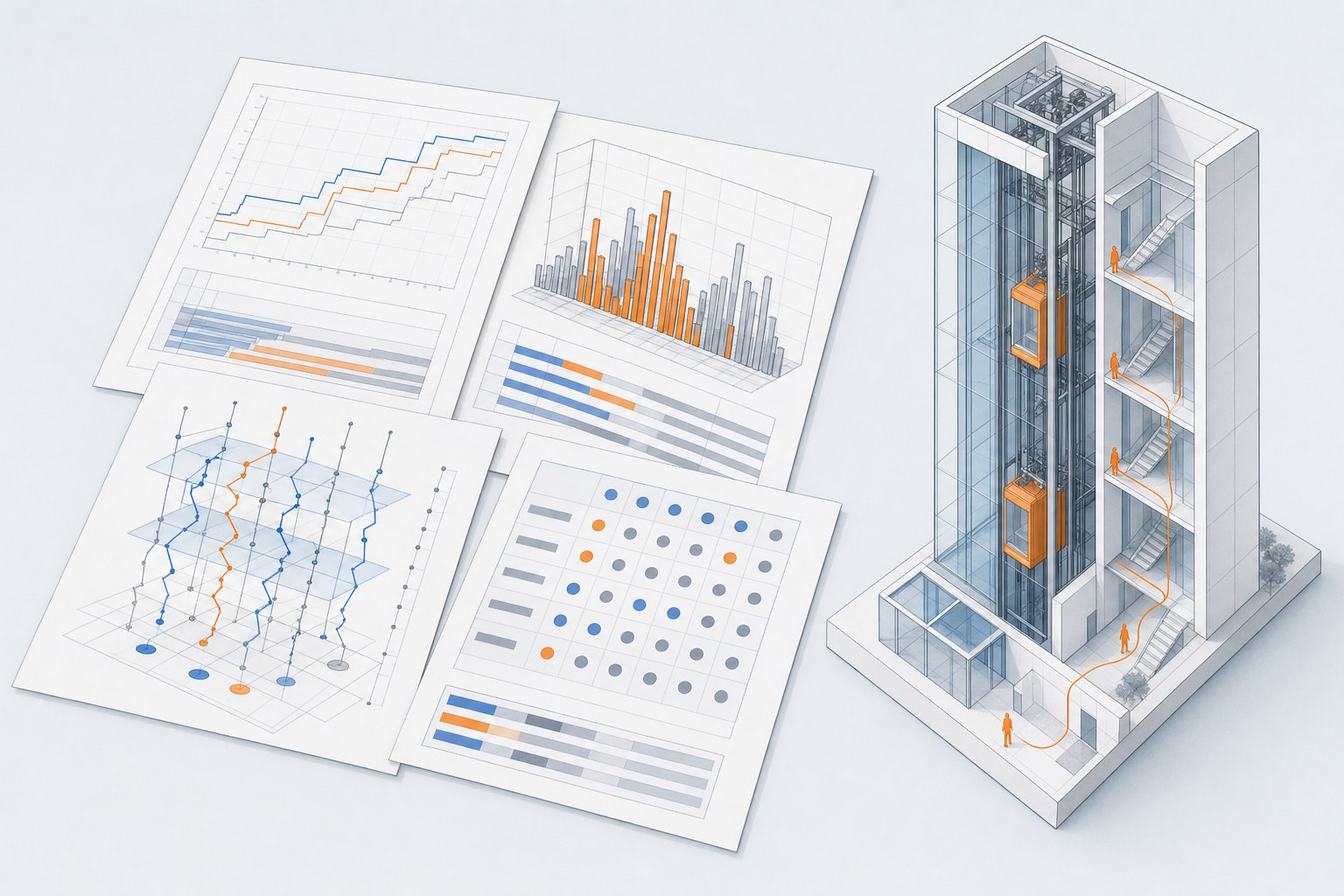
Neither Singapore nor Hong Kong sets a fixed number of passenger lifts for a building. Both set minimums for fire lifts, from 1 to 2 in Singapore above 24 m, and leave the rest to the designer, who must show the lifts can carry the building’s traffic.
In Singapore, the Ministry of National Development told Parliament in April 2025 that HDB decides the number of lifts in a public housing block based on the number and type of dwelling units, the block layout and the number of storeys. Those are the same inputs as a lift traffic calculation. In Hong Kong, the EMSD’s energy guidelines for lifts accept that the number and capacity of lifts are often set by rule of thumb, but ask designers to aim for the shortest practical interval.
So the lift requirements Singapore and Hong Kong publish tell you how a lift must be built, protected, tested and maintained; the traffic design tells you how many lifts the building needs, and how large and fast they should be. The usual design references are CIBSE Guide D and ISO 8100-32, which set out the calculation and simulation methods and typical design criteria for offices, hotels and residential buildings. For residential towers in particular, see our guide to how many lifts per apartment.
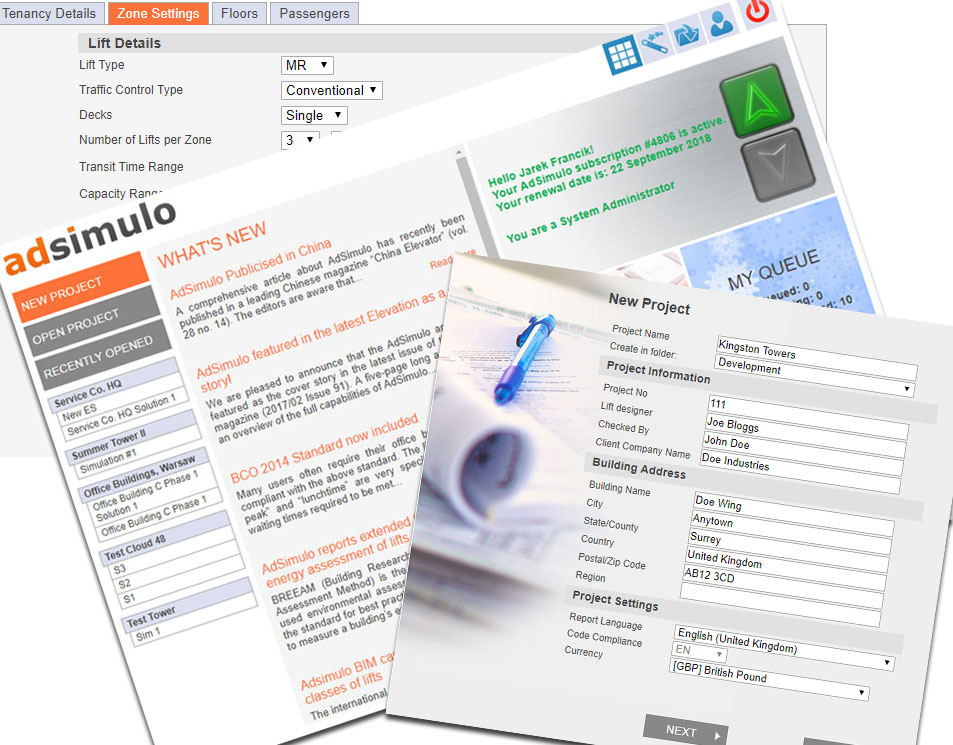
High-rise towers in both cities often go well beyond the point where a single lift group can serve every floor, so zoning, express zones and sky lobbies come into play. Our guide to lift planning for high-rise buildings covers those decisions, and AdSimulo’s lift traffic simulation software lets you model each passenger, compare configurations and check the result against your chosen design criteria.
Checklist for a Lift Project in Singapore or Hong Kong
For a new lift project in Singapore or Hong Kong, settle 5 things early: the traffic design, the fire lift provision, the accessibility features, the code edition that applies, and the permit and maintenance route. Each one affects the size of the core.
A practical sequence for most projects is:
- Run the traffic design first. Use a calculation, then a simulation for complex buildings, to set the number, size and speed of the lifts.
- Check the fire lift rules. In Singapore, apply the 24 m and 40-storey triggers in the SCDF Fire Code; in Hong Kong, apply Part D of the fire safety code.
- Check accessibility. Size at least one car for wheelchair users and, in Singapore, for evacuation of people with disabilities where the fire lift doubles as an evacuation lift.
- Confirm the code edition. In Singapore, confirm whether SS 550:2020 or the 2009 edition applies to the project; in Hong Kong, use the current EMSD codes of practice.
- Plan for operation. Budget for annual testing, permits and maintenance by registered contractors, and for keeping records that the regulator can audit.
The full lift requirements Singapore and Hong Kong apply are set out in the official sources: the BCA’s page on fixed installations legislation, clause 6.6 of the SCDF Fire Code 2023, and the EMSD’s introduction to the Lifts and Escalators Ordinance. For a similar code summary for India, see our guide to lift requirements in NBC India.