Up peak analysis is the study of a fifteen-minute window that, for most office buildings, sizes the entire lift installation. Between roughly 8:45 and 9:00 a.m., a large share of the population arrives at the ground floor and wants to go up. If the lifts cope with that, they cope with the rest of the day. Up peak analysis is how you find out whether they will, and it usually decides the whole design.
Why the morning rush governs
The up-peak is the hardest traffic condition a passenger lift group faces, which is why up peak analysis is the cornerstone of lift sizing. Demand is one-directional and intense: everyone is travelling up from a single terminal floor at once. Cars fill at the lobby, make their delivery stops, and return empty, which is the least efficient cycle a lift can run. If the group can clear the up-peak to target, almost every other period of the day is easier.
That is why traffic engineers treat up peak analysis as the governing case for sizing. Down-peak, when people leave, spreads over a longer period. Interfloor traffic during the day is lighter. The morning arrival surge is the stress test, and a lift group is specified to pass it.
What up peak analysis measures
Up-peak analysis of the building produces the same core metrics as any traffic study, read specifically for the arrival window:
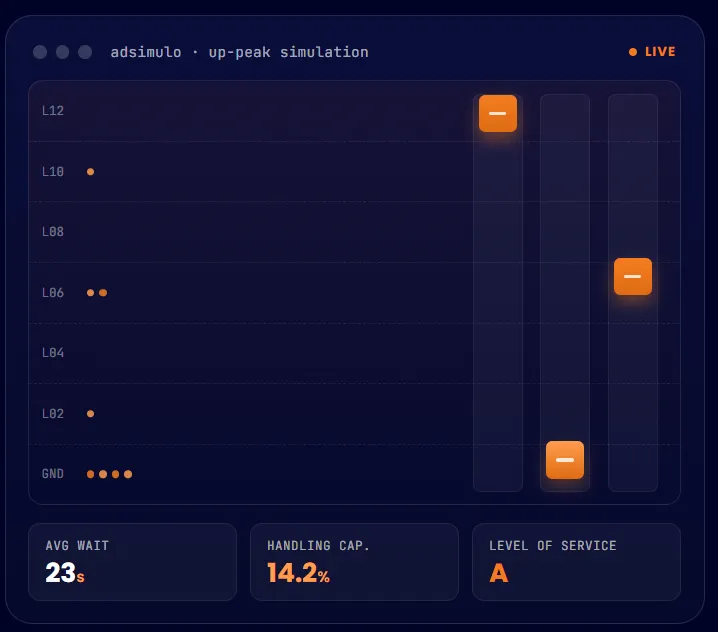
Up-peak interval — the average time between car departures from the main terminal during the peak. This is the classic up-peak quality measure.
Up-peak handling capacity — the percentage of the population the group can lift in five minutes, the %POP figure.
Average waiting time during the peak, the delay occupants actually experience while queuing in the lobby.
A design is judged by whether these sit within target. A common benchmark for a good-quality office is a handling capacity around 12% or more of the population in five minutes, with an interval comfortably under 30 seconds, though the exact targets depend on the building’s grade.
How the up-peak is modelled
The traditional method behind this analysis calculates round trip time for a single car carrying a typical up-peak load, then derives interval and handling capacity. Round trip time accounts for the number of stops a full car is likely to make, the time lost at each stop for doors and passenger transfer, and the travel time over the building’s height. It is a well-established calculation and a sound first pass for a conventional building.
The limitation is that round trip time calculation assumes an idealised, evenly distributed load. Real arrivals cluster, and cars do not fill to a neat average. Simulation-based the analysis models the actual stream of arriving passengers and the dispatch logic that assigns them to cars, capturing the lumpiness the calculation smooths away. For buildings with destination dispatch or multiple zones, simulation is the only method that represents the up-peak honestly.
What up peak analysis tells you about the design
The value of the up-peak study is diagnostic. When the peak fails its targets, the metrics point to the cause. A long interval with adequate capacity suggests too few cars. Adequate interval but low handling capacity suggests cars that are too small. A long journey time in a tall building suggests insufficient speed. Each symptom maps to a lever, and each lever can be tested in software before it costs anything on site.
AdSimulo automates exactly this search. You set the building population, tenancy and target level of service, and its Expert System runs thousands of up-peak simulations to return the configuration that meets the target, rather than leaving you to adjust and rerun by hand. The real-time 3D visualisation then shows the up-peak playing out, the lobby queue forming and clearing, so the diagnosis is visible, not just tabulated.
Beyond the up-peak
The up-peak governs most offices, but not every building. In buildings with heavy lunch-time movement, two-way traffic can be the harder case, and a design tuned only for the up-peak may disappoint at midday. The discipline is to size on the up-peak through up-peak analysis of the building and then verify the other periods, rather than assuming the morning case covers everything. A modern study checks up-peak, lunch-time two-way and down-peak and confirms the design passes the governing one.
Where the benchmarks come from
The up-peak targets used in UK practice trace back to the recommendations in CIBSE Guide D, the standard reference for transportation systems in buildings, which sets out the service criteria and population assumptions traffic engineers design to. The CIBSE knowledge portal is the authoritative source for the current guidance. Designing to those benchmarks is what lets a consultant defend a configuration to a client or a planning authority.
What to do next
Treat the up-peak as the governing case, size the group to clear it within target through this analysis, and then verify the other traffic periods. To run an the analysis that searches automatically for the configuration meeting your targets, see the lift traffic analysis workflow.
Why is the up-peak the worst case for lift design?
Because traffic is intense and one-directional. Everyone travels up from one floor at once, so cars fill at the lobby, make multiple delivery stops and return empty, the least efficient cycle. A group that clears the up-peak handles easier periods comfortably.
What is a good up-peak interval?
For a good-quality office, an interval comfortably below 30 seconds is typical, with premium buildings targeting nearer 25 seconds or less. The right figure depends on the building’s grade and the client’s brief.
Does the up-peak always govern the design?
Not always. In buildings with heavy midday movement, lunch-time two-way traffic can be the harder case. Good practice sizes on the up-peak and then verifies the other periods rather than assuming the morning case is always worst.
Can up peak analysis be done by calculation alone?
For a conventional building, a round trip time calculation gives a reasonable up-peak result. For destination dispatch, zoning or sky lobbies, simulation is needed because those systems behave in ways calculation cannot capture.
We use cookies to improve your experience on our site. By using our site, you consent to cookies.
Cookie Preferences
Manage your cookie preferences below:
Essential cookies enable basic functions and are necessary for the proper function of the website.
Name
Description
Duration
Cookie Preferences
This cookie is used to store the user's cookie consent preferences.
30 days
Cookie Preferences
This cookie is used to store the user's cookie consent preferences.
30 days
Google reCAPTCHA helps protect websites from spam and abuse by verifying user interactions through challenges.
Name
Description
Duration
_GRECAPTCHA
Google reCAPTCHA sets a necessary cookie (_GRECAPTCHA) when executed for the purpose of providing its risk analysis.
179 days
Google Tag Manager simplifies the management of marketing tags on your website without code changes.
Name
Description
Duration
td
Registers statistical data on users' behaviour on the website. Used for internal analytics by the website operator.
session
cookiePreferences
Registers cookie preferences of a user
2 years
Statistics cookies collect information anonymously. This information helps us understand how visitors use our website.
SourceBuster is used by WooCommerce for order attribution based on user source.
Name
Description
Duration
sbjs_session
The number of page views in this session and the current page path
30 minutes
sbjs_udata
Information about the visitor’s user agent, such as IP, the browser, and the device type
session
sbjs_first
Traffic origin information for the visitor’s first visit to your store (only applicable if the visitor returns before the session expires)
session
sbjs_current
Traffic origin information for the visitor’s current visit to your store
session
sbjs_first_add
Timestamp, referring URL, and entry page for your visitor’s first visit to your store (only applicable if the visitor returns before the session expires)
session
sbjs_current_add
Timestamp, referring URL, and entry page for your visitor’s current visit to your store
session
sbjs_migrations
Technical data to help with migrations between different versions of the tracking feature
session
Marketing cookies are used to follow visitors to websites. The intention is to show ads that are relevant and engaging to the individual user.
Facebook Pixel is a web analytics service that tracks and reports website traffic.