Elevator Traffic Study: How to Perform One Step by Step
papi
Updated on
An elevator traffic study is only as good as its inputs and only as useful as its targets. Get the population wrong and every downstream number is wrong; skip the targets and you have a report nobody can act on. This is the working method, in order, for producing an elevator traffic study that holds up.
The steps below take you from a blank page to a recommendation a client or planning authority can accept. None of them is hard in isolation; the discipline is doing them in the right order and not skipping the unglamorous early ones, because an elevator traffic study lives or dies on its inputs.
Step 1: Establish the building population
Every metric in the study derives from how many people use the building, so this is the input that matters most. Population is usually estimated from net internal area and an occupancy density appropriate to the tenancy. A dense single-tenant office packs more people per floor than a multi-let building with circulation losses.
Resist the temptation to use a round number. A 10% error in population can move handling capacity across the pass/fail line, so base the figure on the actual floor areas and a defensible density, and record the assumption so it can be challenged.
Step 2: Define the tenancy and demand profile
Who occupies the building determines how they travel. A single-tenant headquarters produces a sharp morning up-peak as everyone arrives in a tight window. A multi-tenant building spreads arrivals. A hotel mixes guest and service traffic; a hospital adds beds and trolleys to the flow.
Choose the demand profile that matches the tenancy, because it sets the shape of the arrival pattern the elevator traffic study will model. The up-peak is the usual governing case, but for some buildings lunch-time two-way traffic is harder to serve and must be checked.
Step 3: Set the service targets
Before running anything, decide what “good” means for this building. Targets are drawn from the building’s grade and the client’s brief, expressed as ceilings on average waiting time and interval and a floor on handling capacity. A prestige office might set an interval target near 25 seconds; a budget block accepts more.
Without targets, the elevator traffic study produces numbers with no verdict. With them, every result reads immediately as a pass or a shortfall.
Step 4: Specify the candidate elevator group
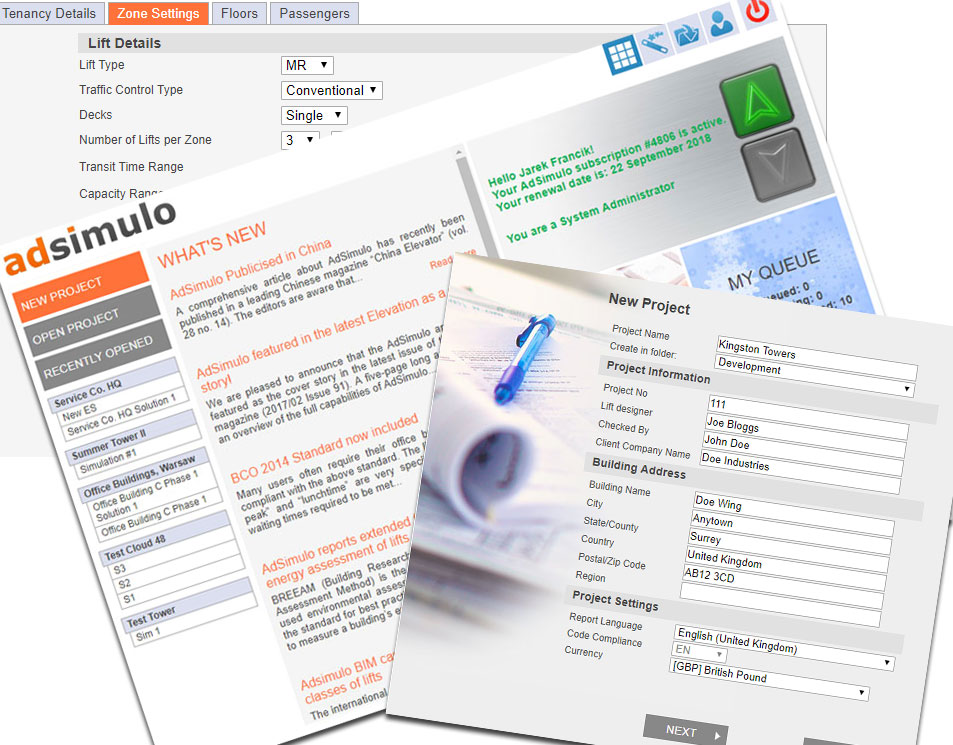
Now describe the installation to be tested: the number of cars, the rated load and resulting capacity, the rated speed, and the dispatch strategy, conventional collective or destination dispatch. These are the levers you will adjust if the design fails its targets.
Step 5: Choose calculation or simulation
For a straightforward up-peak in a conventional building, a round trip time calculation gives a fast and transparent first answer. For anything with destination dispatch, multiple zones, sky lobbies or significant interfloor traffic, use simulation, because calculation cannot represent how those systems actually behave.
Most real studies use both: calculation to get into the right region quickly, simulation to confirm the final specification and to produce the client-facing evidence.
Step 6: Run the analysis
With a calculator, you compute round trip time and derive interval and handling capacity. With simulation, you run many seeded repetitions so the randomness in passenger arrivals averages out, and you read the distribution rather than a single run.
This is where automation earns its place. Tools such as AdSimulo invert the workflow: instead of testing one configuration at a time, you state the target level of service and its Expert System runs thousands of simulations to find the configuration that meets it. An the analysis that once took a junior engineer most of a week collapses into a set of runs and an afternoon of interpretation.
Step 7: Read the results against the targets
Line the output up against the targets from Step 3. If average waiting time, interval and handling capacity all sit inside their limits, the design passes. If one fails, the result tells you which lever to pull: a faster car cuts journey time, a larger car lifts handling capacity, an extra shaft shortens interval.
A 3D visualization helps here. Watching passengers queue and cars bunch during the up-peak makes the cause of a failure obvious in a way a table of numbers does not, and it is far more persuasive when you explain the fix to a client.
Step 8: Iterate and report
Adjust the candidate group, rerun, and confirm the passing design. Then produce the report. The deliverable should show the inputs, the targets, the results and the recommended configuration in a form a client or planning authority can read without translation. AdSimulo’s twenty-three report types cover this, including handling capacity, peak comparison and an executive scorecard that grades the design against the targets you set.
A note on occupancy assumptions
The weakest link in most studies is the population estimate, which rests on occupancy density assumptions. Independent research on how buildings are actually occupied, such as the work published by the US National Institute of Standards and Technology, is a useful reference point when justifying the density you choose, particularly for unusual building types where standard figures may not apply.
What to do next
Work the steps in order and the this study almost writes itself: population, tenancy, targets, candidate group, method, run, read, report. The discipline is in the inputs, not the arithmetic. To see how the automated workflow handles steps five through eight in one pass, explore the lift traffic analysis page.
What inputs do I need before starting an elevator traffic study?
At minimum: the building population, the tenancy type, the floor count and heights, and a candidate elevator group (number of cars, capacity, speed and dispatch type). Service targets must also be agreed before results can be judged.
How many simulation runs are enough?
Enough that the averaged result is stable. Because each run contains random arrivals, a single run is unreliable; a credible the study uses multiple seeded repetitions and reports the average and spread.
Which traffic period should govern the design?
Usually the morning up-peak, but not always. Lunch-time two-way traffic governs some buildings, and down-peak matters where evening egress is critical. Check the periods relevant to the tenancy rather than assuming up-peak.
Can one elevator traffic study cover both UK and US conventions?
The method is identical; only terminology and the referenced codes differ. A study can report in either convention as long as the targets and standards cited match the building’s jurisdiction.
We use cookies to improve your experience on our site. By using our site, you consent to cookies.
Cookie Preferences
Manage your cookie preferences below:
Essential cookies enable basic functions and are necessary for the proper function of the website.
Name
Description
Duration
Cookie Preferences
This cookie is used to store the user's cookie consent preferences.
30 days
Cookie Preferences
This cookie is used to store the user's cookie consent preferences.
30 days
Google reCAPTCHA helps protect websites from spam and abuse by verifying user interactions through challenges.
Name
Description
Duration
_GRECAPTCHA
Google reCAPTCHA sets a necessary cookie (_GRECAPTCHA) when executed for the purpose of providing its risk analysis.
179 days
Google Tag Manager simplifies the management of marketing tags on your website without code changes.
Name
Description
Duration
td
Registers statistical data on users' behaviour on the website. Used for internal analytics by the website operator.
session
cookiePreferences
Registers cookie preferences of a user
2 years
Statistics cookies collect information anonymously. This information helps us understand how visitors use our website.
SourceBuster is used by WooCommerce for order attribution based on user source.
Name
Description
Duration
sbjs_session
The number of page views in this session and the current page path
30 minutes
sbjs_udata
Information about the visitor’s user agent, such as IP, the browser, and the device type
session
sbjs_first
Traffic origin information for the visitor’s first visit to your store (only applicable if the visitor returns before the session expires)
session
sbjs_current
Traffic origin information for the visitor’s current visit to your store
session
sbjs_first_add
Timestamp, referring URL, and entry page for your visitor’s first visit to your store (only applicable if the visitor returns before the session expires)
session
sbjs_current_add
Timestamp, referring URL, and entry page for your visitor’s current visit to your store
session
sbjs_migrations
Technical data to help with migrations between different versions of the tracking feature
session
Marketing cookies are used to follow visitors to websites. The intention is to show ads that are relevant and engaging to the individual user.
Facebook Pixel is a web analytics service that tracks and reports website traffic.